

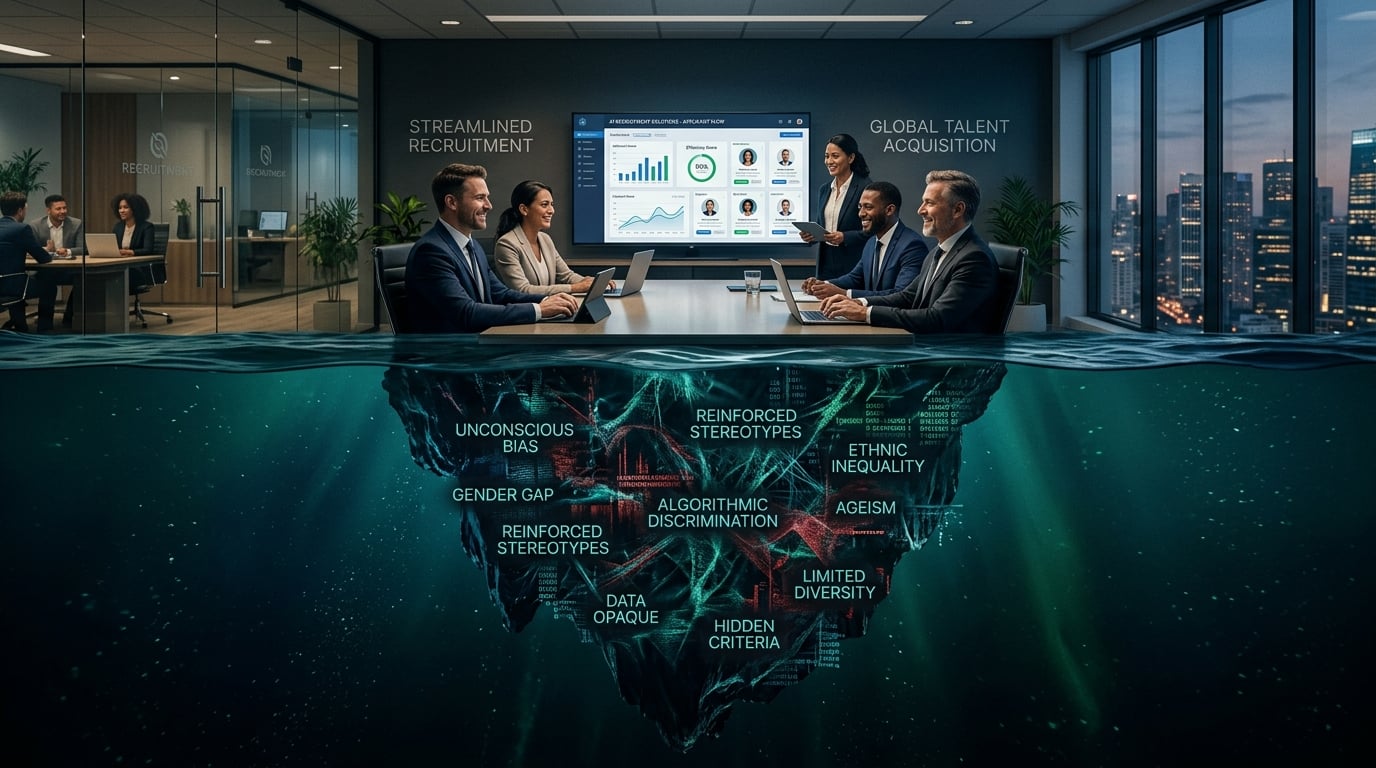
When recruitment AI fails, it seldom announces itself. There is no error message, no system outage, no obvious moment of breakage. The tool keeps running, the shortlists keep appearing, and the failure only becomes visible much later — in a discrimination claim, a regulator's letter, or a quiet realisation that the best candidates never made it past the first filter. That invisibility is precisely what makes these pitfalls so costly. This is a field guide to the ways recruitment AI goes wrong, and what each failure actually costs.
Failure One: Learning the Wrong Lesson From History
The most common failure is baked in at training time. A screening model learns from a company's past hiring, and past hiring reflects past bias. The model dutifully reproduces it, mistaking historical prejudice for a pattern of success.
Amazon's experimental CV tool is the textbook case. Trained on a decade of applications to a male-dominated field, it taught itself to penalise the word "women's" and downgrade graduates of all-women's colleges. The failure was not a bug in the code; it was the system working exactly as designed, on data that encoded a preference the company never intended to automate. The cost, in that instance, was a scrapped project — but only because it was caught internally before it shaped real decisions. Many organisations are not so lucky.
Failure Two: Proxy Discrimination Nobody Spotted
A subtler version survives even careful attempts to be fair. Strip out gender, age and ethnicity, and the model rebuilds them from proxies: postcodes, graduation years, career gaps, club memberships. The organisation believes it has neutralised bias; in fact it has hidden it behind neutral-looking variables that are harder to detect and easier to defend as innocent.
The cost here is legal exposure that arrives without warning. The US Equal Employment Opportunity Commission's first AI hiring-discrimination settlement involved software that automatically rejected women over 55 and men over 60. The pattern surfaced only because an applicant tested it, submitting two identical applications differing solely in date of birth. Until that moment, the employer likely believed its process was fair. The settlement — and the reputational damage of being the first of its kind — followed regardless.
Failure Three: Measuring Something That Isn't There
Some tools fail because they claim to measure the unmeasurable. Emotion- and personality-inference systems that scored candidates from facial expressions or vocal tone rested on science that does not hold: inner states do not map reliably onto outward signals across different people and cultures. A reserved candidate scores as unenthusiastic; a neurodivergent one scores as unstable.
The market recognised this before regulators did — a leading video-assessment provider dropped facial analysis in 2021 — and the EU AI Act has since banned emotion inference in the workplace outright, with penalties reaching €35 million or 7% of global turnover. The cost of this failure is now twofold: the wasted spend on a tool built on sand, and direct regulatory jeopardy for anyone still running one.
Failure Four: Human Oversight in Name Only
Many organisations believe they are protected because "a human makes the final call". But if that human sees only a ranked list and a score, and approves the machine's recommendation ninety-nine times in a hundred, the oversight is decorative. The human has become a rubber stamp, adding legitimacy without adding judgement.
This failure is dangerous precisely because it feels safe. Regulators are increasingly alert to it: the EU AI Act requires that human oversight of high-risk systems be meaningful, with the reviewer genuinely able to override the tool. When a challenged decision reveals that overrides never actually happen, the "human in the loop" defence collapses, and the organisation is left exposed for a process it thought was compliant.
Failure Five: The Model That Drifted
A tool validated at launch is not validated forever. Labour markets change, applicant pools shift, and models retrained on fresh data drift away from their original behaviour. A screener that was fair and predictive in January can develop disparate impact by mid-year without anyone touching a line of code.
The cost of this failure is accumulated risk. Because nothing visibly breaks, drift goes unnoticed until an audit or a complaint forces a look — by which point the tool may have been quietly filtering candidates unfairly for months. Every one of those decisions is a potential liability, and the logs that would have caught it early were often never kept.
Failure Six: Nobody Checked the Rules
Finally, some failures are purely regulatory. Recruitment AI now sits inside a thickening web of law: bias-audit requirements in New York City, consent and disclosure duties in Illinois, high-risk obligations and outright prohibitions under the EU AI Act. A tool can be technically excellent and still unlawful to deploy because a notice was not given, an audit was not run, or a banned function was left switched on.
The cost is direct and quantifiable. Fines under these regimes range from per-violation penalties to figures tied to global turnover. And unlike a bias buried in training data, a missed compliance step is indefensible — it is not a subtle statistical artefact, but a box that was never ticked.
The Common Thread
Across all six failures runs a single theme: the organisation trusted the tool without generating the evidence that it deserved trust. Each pitfall is avoidable, but only by treating recruitment AI as something to be continuously tested, monitored and documented rather than bought and forgotten.
The organisations that end up in headlines are, almost without exception, the ones that deployed on faith. The ones you never hear about verified first. The hidden pitfalls of recruitment AI are hidden only from those who choose not to look.