

The promise of a CV-parsing tool is seductive: feed it thousands of applications, and it will surface the best candidates faster and more consistently than any tired human reviewer. No bad moods, no unconscious bias, no shortcuts on a Friday afternoon. Just pure, objective merit.
The reality is more troubling. A CV-parsing tool is not a neutral referee. It is a pattern-matching machine trained on human decisions, and human decisions carry human prejudice. Far from removing bias, a poorly built tool can encode it, scale it, and lend it the false authority of mathematics.
How the Machine Learns to Discriminate
Most CV-screening systems are trained on a company's own hiring history: the applications that came in, and the decisions recruiters made. The model's job is to learn what distinguished the people who were hired from those who were not, and to apply that pattern to new candidates.
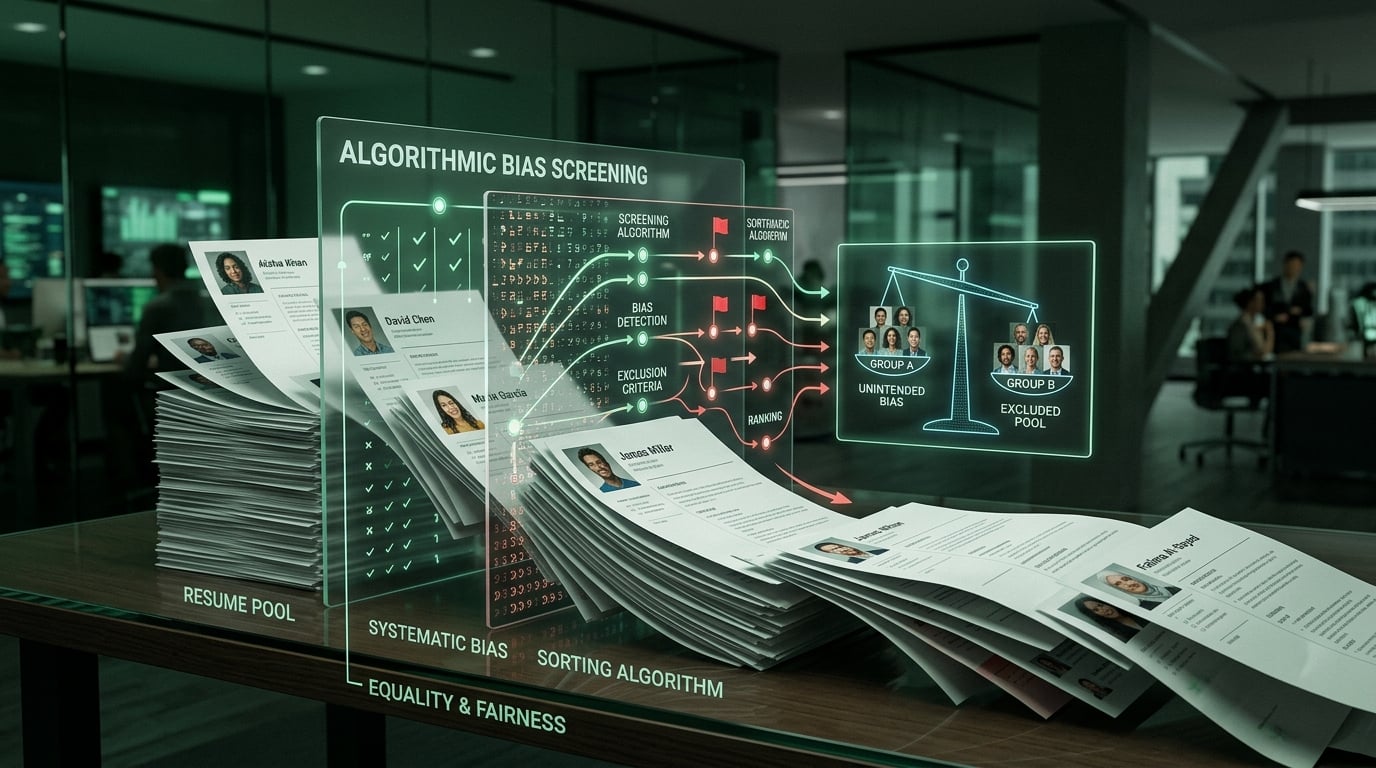
The flaw is obvious once stated. If a company historically hired mostly men for technical roles, the model learns that whatever correlated with being male also correlates with being a good candidate. It does not need to be told anyone's gender to do this. It simply notices that successful past applications shared certain features, and rewards those features — even when the real cause of their historical success was human bias, not talent.
This is not a hypothetical. Amazon built an experimental CV-scoring tool and trained it on a decade of applications submitted to a male-dominated industry. The system taught itself to penalise CVs containing the word "women's" — as in "women's chess club captain" — and to downgrade graduates of two all-women's colleges. It had inferred, correctly, that maleness had historically predicted a hire, and it acted on that inference. Amazon could not guarantee the bias would not resurface in other forms, and scrapped the project.
Proxy Discrimination: Bias That Survives Deletion
The instinctive fix — delete gender, age and ethnicity from the data — does not work, and understanding why is essential. Protected characteristics leave fingerprints all over a CV in the form of correlated variables, and the model reconstructs what you deleted from what you left behind.
Postcodes correlate strongly with ethnicity in many cities. Membership of certain clubs correlates with gender. The name of a school, the year of graduation, a gap in employment, even the phrasing of achievements can all serve as proxies for protected traits. A model denied direct access to age will happily infer it from graduation dates and penalise accordingly — which is precisely the mechanism behind age-discrimination complaints against automated screening. Strip out the obvious fields and the discrimination continues through the back door, now harder to detect because it hides behind seemingly neutral data.
Why Historical Data Is a Trap
The deeper problem is that CV-parsing tools optimise for the past. They are built to find candidates who resemble people who succeeded before — but "succeeded before" is measured inside a system that may itself have been biased. If certain groups were rarely hired, rarely promoted, or rarely retained, the data reflects those outcomes as fact, and the model treats them as targets to reproduce.
This creates a feedback loop. The tool favours candidates resembling past hires; those candidates get hired; their profiles reinforce the pattern; the tool becomes more confident in a bias it should have been challenging. Left unchecked, an automated screener does not correct historical imbalance — it entrenches it, generation of hires after generation, at machine speed.
The Legal Reckoning Has Begun
For years, the discrimination hidden inside hiring algorithms was invisible and unaccountable. That is changing fast. The US Equal Employment Opportunity Commission reached its first AI hiring-discrimination settlement against a company whose recruitment software automatically rejected older applicants — women over 55 and men over 60 — a pattern uncovered when an applicant submitted two otherwise identical applications differing only in date of birth.
Litigation is also reaching the tool vendors themselves, not just employers. A prominent US class action has advanced the theory that a provider of hiring-screening technology can be held liable for discriminatory outcomes as an agent of the employers using it — with the case certified to proceed on behalf of a very large group of older applicants. The message to both buyers and builders is unambiguous: "the algorithm did it" is not a defence.
What to Do About It
The answer is not to abandon CV-parsing tools, but to stop treating them as objective by default and start demanding evidence that they are fair.
Test outputs for adverse impact. Run the four-fifths analysis across gender, age and, where lawful, ethnicity, on the tool's real decisions — not the vendor's brochure. A selection rate for any group below 80% of the top group's rate is a red flag that demands investigation.
Hunt for proxies. Ask which features drive the model's scores, and interrogate whether any could stand in for a protected characteristic. If the vendor cannot explain what the model weighs, that opacity is itself a reason for caution.
Question the training data. Ask what population the model learned from and what outcome it was taught to predict. A model trained to imitate past hiring decisions inherits the bias of those decisions; a model validated against genuine job performance is on firmer ground.
Keep a human genuinely in control. Ensure a person reviews candidates with enough context to overrule the machine, and record when they do. Oversight that never changes an outcome is not oversight.
Monitor continuously. Bias can emerge after launch as data shifts, so re-run the analysis on a schedule and define the threshold that triggers a pause.
A CV-parsing tool can be a legitimate aid to fair, efficient hiring. But it earns that status only through evidence — never through the assumption that because a machine made the decision, the decision was neutral.